
“It’s not everywhere in the country that [FAFSA completion] is a priority, so it means something that we’re all here together,” said Chris Soto, Senior Advisor to the Secretary for the U.S. Department of Education, to a room full of educators gathered for the Connecticut FAFSA Summit. “It’s not an understatement to say that the people in this room are leading this country and you are a critical element of that leadership,” he continued.
The CT State Department of Education hosted its first-ever FAFSA Summit in partnership with the RISE Network for a community of educators representing the 51 schools engaged in the 2024-25 CT FAFSA Challenge.
The objective was to facilitate a space where participants could work together to explore and exchange successful strategies and innovative approaches to increase FAFSA completion rates within their schools.
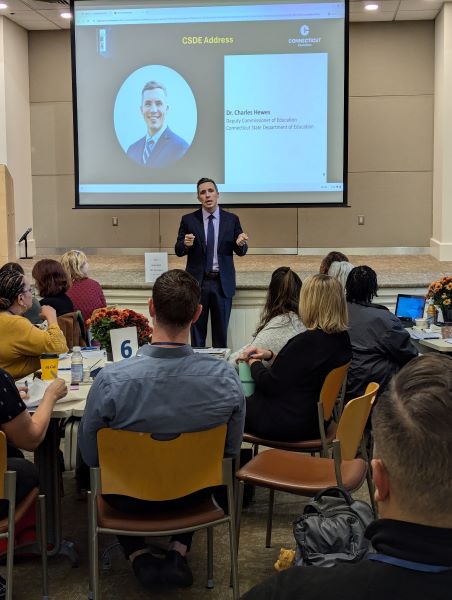
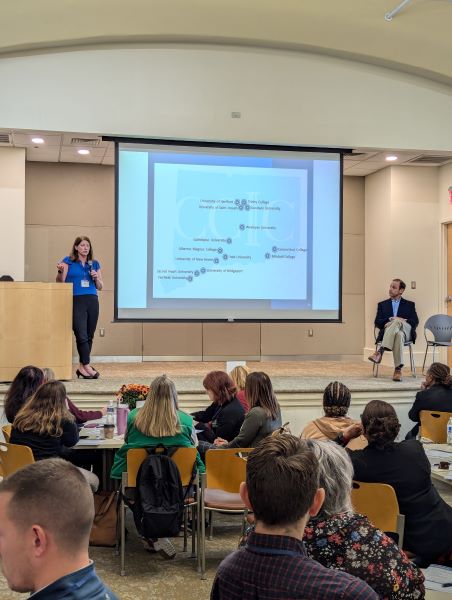
Soto was the keynote speaker, along with Dr. Charles E. Hewes, who serves as Deputy Commissioner of Education for the CT State Department of Education. Participants also heard from Steve McDowell, Associate VP for Financial Aid Services & Title IV Compliance for CT State Community College, who shared information about the State’s free tuition program; as well as Jennifer Widness, President of the CT Conference of Independent Colleges, who spoke on scholarship resources for CT high school students.
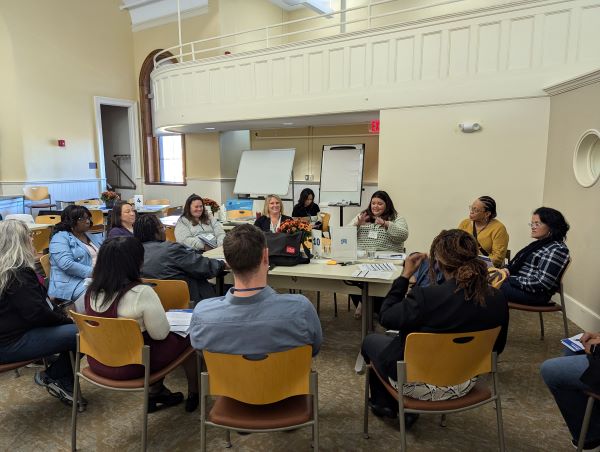


From there, participants moved through five “stations of innovation” – roundtable discussions led by educators from schools in the FAFSA Challenge network – each focused on a promising practice they had employed in their school to help improve FAFSA completion rates.
Stacey Rosado, Counseling Lead at New Britain High School, explained how her team served their diverse student population by providing FAFSA support in multiple languages, including Spanish, Polish, and Arabic. New Britain hosted conferences for families to connect with staff, as well as “FAFSA Frenzy Fridays,” where students could attend a workshop or receive individualized help. Speaking to the success of their outreach, Rosado shared that around 70 percent of English language learners completed their FAFSA or AACTUS forms last year, significantly surpassing the overall national average of 48 percent.
Representing Norwich Free Academy (NFA), Postsecondary Success Counselor Anne Zinn shared how her school promotes FAFSA awareness. NFA’s “What’s Next for Me” program includes a series of opportunities for students to explore postsecondary options, starting in Grade 9 and continuing through Grade 12. To kick off senior year, NFA holds a grade-wide assembly; workshops on college, military, and workforce pathways; and a financial aid session focused on the FAFSA. All 580 students in NFA’s Class of 2024 participated in the assembly and were assigned to two of the workshops, ensuring that they were prepared to complete the necessary steps to graduation.
“The goal of the program is to ensure that students are not waiting to think about their future until the fall of senior year,” said Zinn. “They are starting their senior year with a plan in mind so that they can complete necessary milestones earlier.” The program has proven its effectiveness, as NFA students achieved a 61 percent FAFSA completion rate; another FAFSA Challenge school surpassing the national average.

Dr. Bobbi-Jo Wathen, Director of School Counseling for Middletown High School, led a roundtable on how she and her team maximize data to move their FAFSA work forward. She explained how she used to maintain a spreadsheet to track student progress, but now uses the RISE Data Hub, a custom-built platform that streamlines information from multiple sources including Naviance, EdSight, and PowerSchool. Wathen said that Middletown – also a RISE Core Network partner – surveys juniors to help them develop goals for their senior year.
Throughout the 2023-24 academic year, Middletown held biweekly postsecondary improvement team meetings, reviewing goals and data to determine focus areas. Each team member identified five to seven students to connect with and helped them complete a specific step in the FAFSA process. The following meeting, they would review successes and barriers, and then restart the cycle. “Working with a few students at a time creates a shared support system and keeps us going,” Wathen said. “The work of our improvement teams moved us forward and the RISE Data Hub made everything quicker and much more efficient.”
Middletown’s 75 percent FAFSA completion rate earned them a third-place ranking in last year’s FAFSA challenge and Wathen and her team hope to surpass that high benchmark in the year ahead.
The dedication and perseverance of all the educators present at the FAFSA Summit – and across the CT FAFSA Challenge Network – gives a hopeful outlook for the future. Despite ever-present challenges, these educators have proven that they will go above and beyond, piloting creative new solutions to support their students. In his keynote, Soto praised the Summit participants, noting, “When I look at you, I see equity champions who meet students and families where they’re at, transforming young lives. That moment when they hit submit, their face lights up, and it’s life-changing.”