
Recently, the U.S. Department of Education published a long-awaited report on the future of the Institute for Education Sciences (IES), the federal research arm that studies educational improvement strategies from early childhood through postsecondary.
The report emphasizes the need for IES to better connect research and practice, so that students and schools can reap the benefits of everything the field is learning about what works, and why and how it works, from IES-funded studies. It reminds us that the most important step in research is getting the findings into the hands of those doing the work, especially our country’s dedicated educators.
Among the proposals to modernize IES, the report’s author argues that we need research topics that are more relevant to the needs of today’s schools and learners, research methodologies that deliver more timely insights, and research products that offer practical steps teachers, counselors, and principals can take right away to improve practices in their classrooms and schools.
Here at RISE, we’ve seen firsthand that such actionable research can truly transform the way our school partners are able to tackle seemingly intractable challenges to reimagine the high school experience for students.
Ten years ago, when RISE was just getting started, we were motivated by high-quality research from the University of Chicago, which showed that Grade 9 on-track achievement was the best predictor of whether a student would graduate from high school four years later.
At the time, one-third of ninth graders in RISE Core Network schools were off track at the end of the school year. While the research pointed to Grade 9 as a critical juncture, it’s what happened next that was most important: the widespread exploration and adoption of educator-led innovations focused on catching kids before they fell behind.
From the get-go, we knew that one-size-fits-all solutions wouldn’t cut it. RISE supported school partners to adopt improvement strategies drawn from existing research, but carefully tailored to their school context and targeted to address their students’ distinct needs.
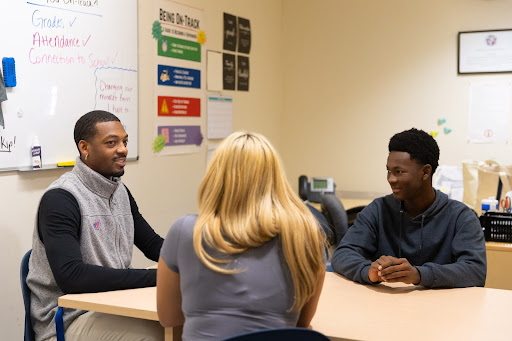
For example, school teams piloted Summer Bridge programs to set incoming ninth graders up for success before the first day of high school. They also hired On-Track Coaches to monitor and support students’ success during the pivotal Grade 9 transition year.
Critically, RISE partnered with educators to study the efficacy of their interventions. Educators looked at data, openly shared their successes and setbacks, and had access to the inspiration and tangible support they needed to make adjustments and continuously improve.
As a result of these efforts, RISE partner schools have improved Grade 9 on-track rates by 15 percentage points, from 67% to 82%, tripling the likelihood these students will graduate on time.
Our experience showcases why we believe that the future of education research demands more than connecting outside research with classroom practice, as valuable as that is. We actually need to build research into the day-to-day practice of our schools.
Every year, new students enter RISE partner schools, and with these fresh faces come new opportunities and experiences. While educators should never have to start from scratch, change is inevitable. Therefore, studying their practice and deepening their understanding of what might work best for these students in this place at this moment in time must be an enduring part of the job.
That’s where the R-I-S-E Continuous Improvement Cycle comes in. Our four-part process draws on research and data to support school teams in designing, piloting, and learning from their change ideas and innovations. It positions teachers, counselors, and principals — not outside experts — as key researchers and problem-solvers in their buildings.
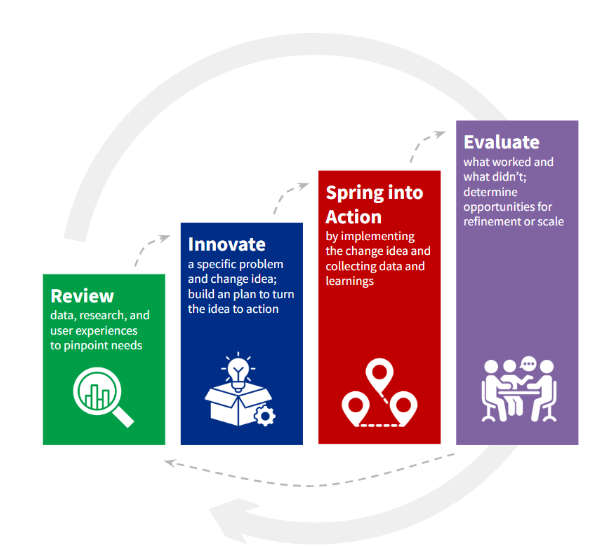
In the RISE 2025 annual report, Dr. Leslie Torres-Rodriguez, former superintendent of Hartford Public Schools, explains that this cycle was instrumental in helping her team build their continuous improvement “muscles” and “keep up their reps” through weekly, monthly, and quarterly routines and protocols.
By building educators’ capacity to use research to co-design and test innovations and engage in continuous improvement, RISE is proud to have supported Hartford high school partners to reduce rates of chronic absenteeism for ninth graders across the board, improve on-track rates for key subgroups of students, and increase 4-year graduation rates by an average of 10 percentage points across schools.
For this school-embedded research to work, educators need the right information, at the right moment, to inform and guide the right decision or next step. This requires data in lots of different forms, for lots of different people — not just researchers.
“Researchers can’t be the only ones with access to the data,” explains Chris Lewine, Chief of Data Strategy and Product Innovation at RISE. “Practitioners need visibility into how their students are performing on each research-backed predictive indicator. And the data needs to be real-time and interactive to be actionable.”
The RISE Data Hub is a powerful tool for supporting school-embedded research, learning, and continuous improvement. RISE designed the Hub alongside educators, based on their day-to-day work with students and one another; as educators have become ever more sophisticated researchers, the Hub has grown right along with them. Today, it integrates a wide range of data connected to improvement teams’ on-track and postsecondary goals, and pairs that information with protocols educators can use right away to analyze progress, diagnose gaps, and take purposeful action.
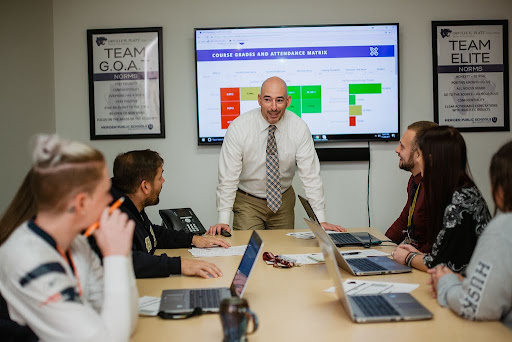
For example, the KidStat Data Protocol continues to be one of the most widely used RISE data tools. By integrating indicators from the Hub with qualitative insights from educators who know their students best, this protocol supports improvement teams to hone in on the needs of an individual kid, hypothesize on the interventions most likely to make a difference based on that student’s unique profile and circumstances, and generate specific, timebound action steps — all in about 15 minutes.
To be sure, the RISE Monitoring, Evaluation, and Learning Team also uses the Hub and documentation from our school partners’ improvement cycles to codify lessons for the broader RISE network. Whereas our Issue Briefs provide valid, reliable information about what past research can tell us about an important topic, our Learning Briefs capture more recent insights and promising practices — the relevant, timely, and practical tips educators need.
Take our 2024-25 Summer Academy Learning Brief. This resource highlights the important outcomes our partner schools achieved by offering postsecondary planning support for rising seniors, including higher rates of both college application and FAFSA submissions. It also pairs those results with tips from educators on how to implement the programming well, like including financial planning/FAFSA completion sessions specifically for parents and caregivers, and tapping seniors to help recruit juniors to participate in next year’s programming.
While reports, research studies, and data tools can add immense value to educators’ continuous improvement efforts, to keep up momentum over time we know that they need something equally important: each other.
Improvement is hard. Outcomes can plateau. Strategies that worked last year are suddenly less effective this year. That’s the moment when educators need partners — colleagues who’ve grappled with similar challenges and can offer both hope and practical guidance, all based on research-backed practices carefully adapted to their distinct contexts.
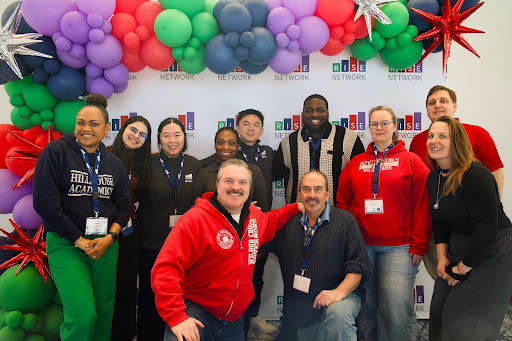
“Our team puts a ton of effort into connecting educators to one another,” explains Nichelle Woodson, RISE Chief of Network Success. “Our professional learning experiences aren’t your typical one-and-done PD. Teachers, counselors, and school leaders have opportunities to build deep, trusting, mutually supportive relationships that they carry with them the rest of their careers. ”
Through the RISE Network, educators have access to brilliant colleagues, whether across town or across the country, who are only a phone call away. This matters because answering the question, “What can I try next?” is not a one-time exercise. Our understanding of what students need — of what works, for whom, and under what conditions — is constantly growing and evolving.
Thousands of educators in the RISE Network are seamlessly connecting research and practice in their schools. The future of education research is already here.
| At RISE, we are eager to partner with high schools committed to building research and continuous improvement into their daily practice. Check out our RISE in Action: Virtual Learning Series resources to hear more research-backed lessons and practical tips from our network. Then connect with our team to explore which of our professional learning opportunities, including our Convenings, Symposiums, and Focus Networks, could be the right fit to help you reach your goals. |