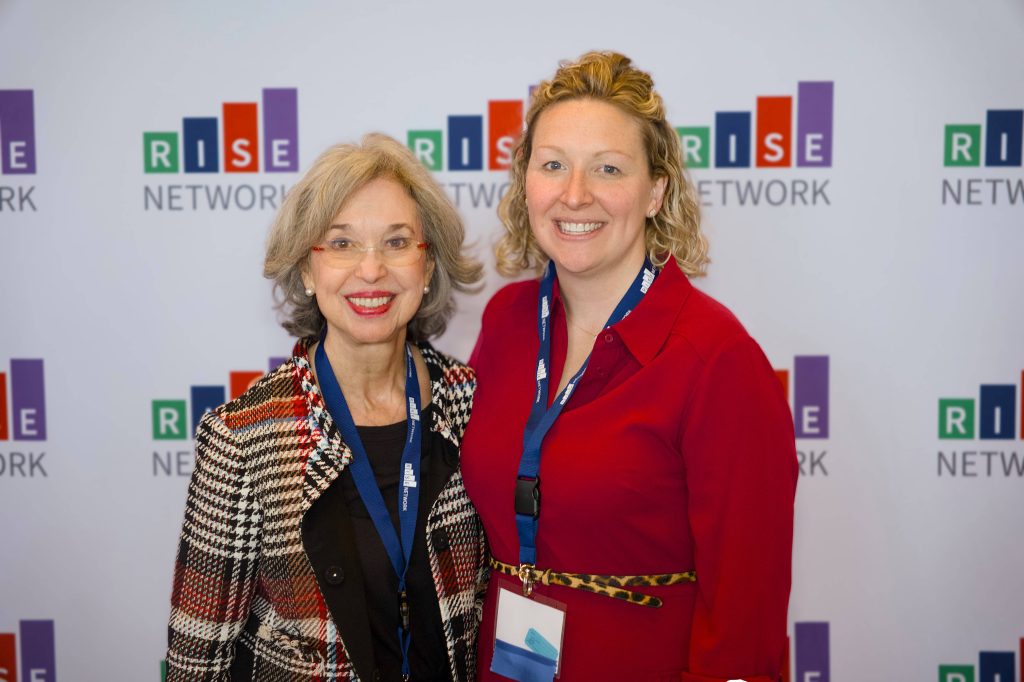
As part of the RISE Network’s ongoing tenth anniversary celebrations, we sat down with Co-Founder Barbara Dalio to look back on the organization’s origin story, discuss the role of relationships in school and system improvement, explore what she sees as keys to successful partnerships between philanthropy and education, and much more.
You can catch up the first three installments of our RISE co-founder interview series here, here, and here.
Our conversation has been lightly edited.
Alexandra Broin: In recent months, I’ve connected with 40 some odd students, teachers, school counselors, on-track coaches and mentors, principals, assistant principals, local and national philanthropic leaders, and longtime team members from across the RISE Network. Each has shared their version of RISE’s origin story, and the narratives have been revealing. Your turn!

Barbara Dalio: For me, the story actually starts more than 15 years ago. My four sons were growing up — were grown up, really! — and moving into the next phases of their young adult lives. I found that I was at a turning point, too, both personally and professionally.
Early on in my career, I had been working at the Whitney Museum, but then stepped away to raise my four children. As a parent, my focus turned from art to education. I spent a lot of time in my children’ s schools and I learned a lot. I developed a tremendous regard for the teachers who drove me as a parent to do a better job, had deep admiration for how hard the teachers and leaders worked to serve the children, and was impressed with the big differences that they made.
I didn’t grow up in the United States, and I was inspired by the public-school model which serves every child. I knew education from the viewpoint of a parent, but I recognized that wasn’t the full picture. I wanted to better understand the perspectives and experiences of teachers and principals working in schools every day.
I began visiting more and more schools, and found that I had a strong connection with the teachers, principals, and their goals. As the Dalio Foundation was growing, I wanted to find an area where I could provide meaningful and practical help. This was it. At first, the donations were small but impactful. Over time, they became larger as I understood the complexity and needs in public education.
I began by supporting an organization in Norwalk. I told them I wanted to listen and learn — that’s it. I was introduced to so many school leaders and teachers, including a local union leader who helped me set up a series of school visits with lots of different people in education. That’s really where everything that would become RISE started, in those classroom visits and early conversations with educators and education officials.
AB: What did you talk about back then?
BD: I asked a lot of questions. There was so much I didn’t know! The educators I spoke with were so kind and patient with me. They really encouraged me and were so generous with their time. I can’t tell you how much I appreciated that. Their support gave me the courage to keep asking questions and to keep learning. With their support, I began developing a much deeper understanding of and appreciation for the work of teachers and the complexities of running a school and district.
AB: What was your biggest question for educators 10+ years ago?
Looking back, the most important question I asked was actually quite simple: How can I help? It’s still the most important question I ask educators today.
AB: What was their response to that simple, yet powerful prompt? What support did educators tell you they needed?
BD: As just one example, the first school I worked with really closely was Richard C. Briggs High School, an alternative program in Norwalk, CT. I got to spend time with teachers and students in a more intimate way, and learned so much.
Back then, the school wasn’t getting the results they wanted for their students. The team had applied for a turnaround grant from the state, but they were rejected. They really needed it. Like all educators, everyone in the building had a lot on their plate. I told them I saw how busy they were and asked if I could help them find a grant writer to support their improvement plan, which they accepted.
Shortly thereafter, a colleague connected me with Bob Hughes, who was leading New Visions for Public Schools, a nonprofit supporting more than 70 schools in New York City. I really can’t overstate how instrumental Bob was in helping us become the organization we are today. I remember him coming to Norwalk and spending time with the teachers, administrators, and community leaders I was learning from directly. He understood the vision for what we were trying to build and played an indispensable role in those early years, helping us navigate not only the challenges we faced, but also the larger question of what kind of organization we wanted to become. His guidance, insight, and belief in our mission were invaluable as we found our footing and laid the foundation for the work we do today.
AB: I’m starting to get a sense that RISE is right around the corner. What happened next?
BD: My relationship with Bob and New Visions continued. I spent a lot of time visiting their schools — and many others — and learning about effective high school improvement models. I asked Bob if he would consider expanding New Visions to Connecticut. It took a little time, but eventually I convinced him to incubate a new, aligned organization, Connecticut RISE (now the RISE Network), at New Visions. Along with Emily Pallin and Andrew Ferguson, we officially launched RISE in the 2015-16 school year.
AB: What were you most excited about?
BD: I can’t believe I’m going to say this, but data. Seeing how New Visions’ data-driven approach supported so many different school models helped me understand the power of data in new and unexpected ways. I never would have dreamed that I would have the relationship with data that I have today. Learning how data can support school design and the work of teachers, school counselors, and principals across so many different contexts was really compelling to me.
This is also perhaps a function of my personality. I’m an experiential learner and that shapes how I approach the work. I can’t get all of the rich information I need to truly understand what’s going on by reading about it or analyzing it from the outside. I have to go talk to people and feel what it’s like when things are working and when they’re not. I have to know the humans behind the numbers.
AB: RISE today is an incredibly data-oriented network of schools and the dozens and dozens of staff and educators I’ve spoken with talk about relationships the way you do — as a no-brainer. Why does this feel so remarkable? Why aren’t relationships at the center of other educational models and investments?
BD: Building relationships takes time. When I think back to the first educators I met with, we formed real, authentic relationships, but it didn’t happen overnight. We attended formal events together. We met up at schools all over the state. We grabbed coffee. It’s just a really big investment of time and care. After a while, we became more than colleagues — we became friends. Education is built on these deep human connections.
Today, there is understandable urgency to move fast and go big. We’ve expanded from five partner schools in one state serving 5,000 students, to 60 schools across six states supporting 40,000 students. Other philanthropists might look at RISE’s growth over the past ten years and think our numbers are too small or that our growth is not enough. But true change happens more slowly than many care to admit. If you go too fast, you make mistakes. You miss opportunities because you flew right by them. You can lose something important along the way. Sustaining real, lasting improvement takes clarity, focus, patience, and stamina.
When I look at RISE’s growth numbers, I’m incredibly proud. I know the story they tell. As we’ve welcomed more educators into the network, the relationships we’ve built and the connections we’ve made across school partners have only gotten stronger, which contributed greatly to our and their successes.
AB: It’s clear that this human-centered approach will continue to be core to the RISE model during the next ten years. What else was true during your first decade that will continue to be true in the next?
BD: Teachers will continue to be the guide. For RISE and Dalio Education more broadly, that will never change. Educators are the ones working with students and families every day and their knowledge and expertise is invaluable. We will continue to uplift educators and ensure they are treated with the respect they deserve. I will continue thinking about how I can help others recognize what an amazing job teachers, principals, and other educators do each and every day — and why it’s so important that improvement is something that happens in partnership with educators, not to them.
In addition, those of us working alongside schools will have to stay curious and nimble with our support — another hallmark of the RISE approach. When I listen to teachers today, it’s very different from what I heard 10 or 15 years ago. We can never assume that what we know will always be true. The world changes. It’s changing very rapidly right now. That’s why hearing from educators consistently is so important. You can start to feel like you know. Like you’ve got this. Like maybe you know more than educators. Your confidence can get in the way of learning and improvement.
Keeping those on-the-ground relationships strong and fresh enables us to keep up with how to help educators and students with the new and evolving challenges and opportunities they face today.
AB: What do you expect will change in the coming years?
BD: There are a few things that are top of mind for me, both connected to technology and artificial intelligence (AI).
First, I’m mindful that technology has and will continue to affect students, both positively and negatively. For example, we know that social media and the rapid growth of technology has changed childhood for kids today. When I hear my friends talking about what’s going on with their children, it feels like a completely different world than when I was raising my sons. In the next few years, we have to keep listening to educators, students, and families to understand how AI is shaping their experiences in real time. We have to keep up, and RISE’s tools and support have to be ready to adapt to new circumstances and needs.
In addition, while I know that data will always be at the center of our work — that it will continue to help us understand and tell the story of what’s happening in our schools — our data systems are going to change because of AI. We need to monitor innovations from the field, which the RISE team is doing in really thoughtful ways, while staying focused on supporting educators’ change ideas. We need to be ready with new capabilities educators tell us they need.
Finally, we need to monitor new technologies with curiosity and a partnership mentality. The other day I heard a story on NPR about a school using new technology to track the time students spend in the restroom. My initial reaction was, are you kidding me? Why would they do that? It’s hard not to judge. But then I paused, took a breath, and moved myself back into inquiry mode. Why would they do that? What problem are they trying to solve? And is that the best or only solution?
As educators grapple with an influx of new and often untested technology, they need supportive, non-judgmental partners who can help them critically reflect on school practices and make decisions. They might not get it right the first time. With the right supports, they can stay focused on continuous learning and improvement.
AB: As you reflect on the past 10+ years, what advice would you offer other philanthropists and those who want to make impactful investments in our schools?
BD: First, start with questions — not solutions. Often, funders come in with an agenda based on our understanding of how schools ought to work. When we bring ideas, they become even better when paired with the experiences and insights of educators and students. The reality is that it’s still uncommon for philanthropists to come to the table with a learning mentality. We’ve got to change that. Real change requires real partnership.
Related, prioritize taking steps to truly understand what’s happening in the schools you want to support. Yes, read the research and look at the data. But make sure you talk to educators and students as much as you can. There are real gaps between schools and external partners, and we can either bridge those gaps or widen them depending on how we choose to approach the work.
I also recommend finding a mentor(s) to guide you when you are starting new partnerships. Keep talking to others working in philanthropy. We have so much to learn from one another, and doing this important work is so much better when you have a community you can call on when questions or issues arise. I said this before and I’ll say it again: relationships really do matter!
AB: Any reflections for the RISE team?
BD: Thank you. I’m so excited about Emily’s leadership and the incredible work this passionate, dedicated team is doing to support our school partners. I can’t wait to see what we accomplish in the years ahead!