

As part of the RISE Network’s ongoing tenth anniversary celebrations, we sat down with Co-Founder and Executive Director Emily Pallin to look back on the organization’s first decade and imagine the possibilities that lie ahead for the growing network of networks. This is the second part of our conversation.
In the first installment of this blog series, we talked about RISE’s origin story and the ingredients that have been key to the organization’s success over the years, especially the power of relationships in creating spaces where educators can be open about both their successes and setbacks. You can catch up on part one here.
Our conversation has been lightly edited.
Alexandra Broin: We’re back! I’d like to pick up where we left off by asking you about how RISE has grown and evolved while maintaining a steady focus on your mission and what you do best. In the 2025 annual report, RISE Board Member Mike Chambers explains that “RISE knows which pillars they are best positioned to influence…. They don’t get distracted. Their sense of clarity and purpose is powerful.”
How have you managed to adapt to the changing landscape and avoid mission creep?
Emily Pallin: This is a constant balancing act! On the one hand, we need to stay nimble and responsive to shifting needs and the ever-changing environment in schools. We experienced this during COVID in so many ways. Prior to COVID, we regularly came together in person for cross-school collaboration. During the pandemic, educators needed support from one another more than before, and we had to invest in a new virtual community. Currently, schools are really struggling with budget decreases and staffing cuts, so we need to prioritize innovations that are scalable in a resource-constrained environment. Things like college application campaigns, Senior Signing Day, and on-track conferences can still happen in really scrappy and high-quality ways. Our work requires constant iteration and resourcefulness!
On the other hand, we also need to stay the course and keep a laser-like focus on our on-track and postsecondary outcome goals, and avoid being pulled in too many directions. We also need to continue leaning into our core strength: our data-driven network improvement model that’s supported so much innovation and progress to date. Our on-track and postsecondary goals are big and ambitious. Let’s use postsecondary as an example. Five years ago, we first surveyed seniors to understand their post-high school plans, and we were shocked to find that one in five graduates did not know their next steps after high school. We focused intently on ensuring all students had a forward-looking plan, and we’ve been hovering between 99% – 100% over the past few years. But the work’s not done! We stay in that same space, but dig deeper, asking questions like: Okay, have all of the students completed applications for financial aid, and do they have financial plans to support their goals? Or, how can we support students to identify their postsecondary goals earlier, so they have more time to build confidence and readiness to succeed in their plan?
We stay focused on the same north-star student outcome goals, and our improvement process allows us to pinpoint high-leverage and timely needs and opportunity areas.
AB: Ed tech is one of those things that can be a tremendous value-add or a huge distraction.
What have you observed about the role of technology in education over the years, and how do you see emerging tech, like AI, fitting into RISE’s highly relational model moving forward?
But the benefits of ed tech don’t simply come from having a new subscription or tool. Having a new log-in does not in and of itself change the student experience. It’s when educators know how to use new technology in combination with their expertise to thoughtfully address students’ needs that we see positive developments.
Emily Pallin
EP: AI is profoundly changing the world around us and has the potential to make important aspects of our work more effective, more efficient, and more thorough. And that doesn’t change the fact that education is and always will be human-centered work.
We believe in and deeply value the benefits technology has brought to classrooms and schools, and the RISE Data Hub is a shining example of what that can look like.
But the benefits of ed tech don’t simply come from having a new subscription or tool. Having a new log-in does not in and of itself change the student experience. It’s when educators know how to use new technology in combination with their expertise to thoughtfully address students’ needs that we see positive developments.
An AI-powered tool might prompt a teacher to consider questions like: What do I need to pay attention to? What else might I try? Are there templates and tools I can borrow to get started?
None of these products or tools will change the fact that we need to connect with students. A highly personalized and fulfilling educational experience happens when technology enhances connections between students, families, and passionate, skilled educators.
AB: AI can’t replace educators?
EP: No, it can’t.
AB: You mentioned the RISE Data Hub. In our information-saturated world, data can feel pretty overwhelming. Yet educators in the RISE Network consistently emphasize the value and user-friendliness of the Hub. Some have shared that the Hub supports them to make smart, big-picture decisions about schoolwide improvement strategies. Others highlight how the Hub helps them to prioritize smaller, more nimble daily action steps aligned to their improvement goals.
How did you account for all of these data needs when designing the Hub?
EP: Educators need access to the right information, at the right moment, to inform and guide the right decision or next step to support their students. No single report or visualization can achieve everything a school needs! The data has to be accessible in lots of different formats for lots of different users, and that’s exactly how we built the Hub.
But it’s important to note that we never set out to be an ed tech company. Our goal, always, has been to provide educators with tools and information that make their jobs a little easier — that amplify the work they are already doing to support their students’ success.
The first thing we did back in 2015 was sit side-by-side with teachers, counselors, and administrators to understand how they were wrangling all of the data they had access to. When meeting with counselors supporting postsecondary planning, we saw that some were using intricate post-it note systems, others had elaborate color-coded legal pads full of notes, and still others were iterating on these massive spreadsheets. Honestly, their workflows were brilliant!
We didn’t invent anything — the educators had already done that. We listened to their needs and pain points. We observed them working and took notes on their processes. And then we built the technology solutions around all of that. The Hub is deeply connected to and reflective of educators’ day-to-day work.
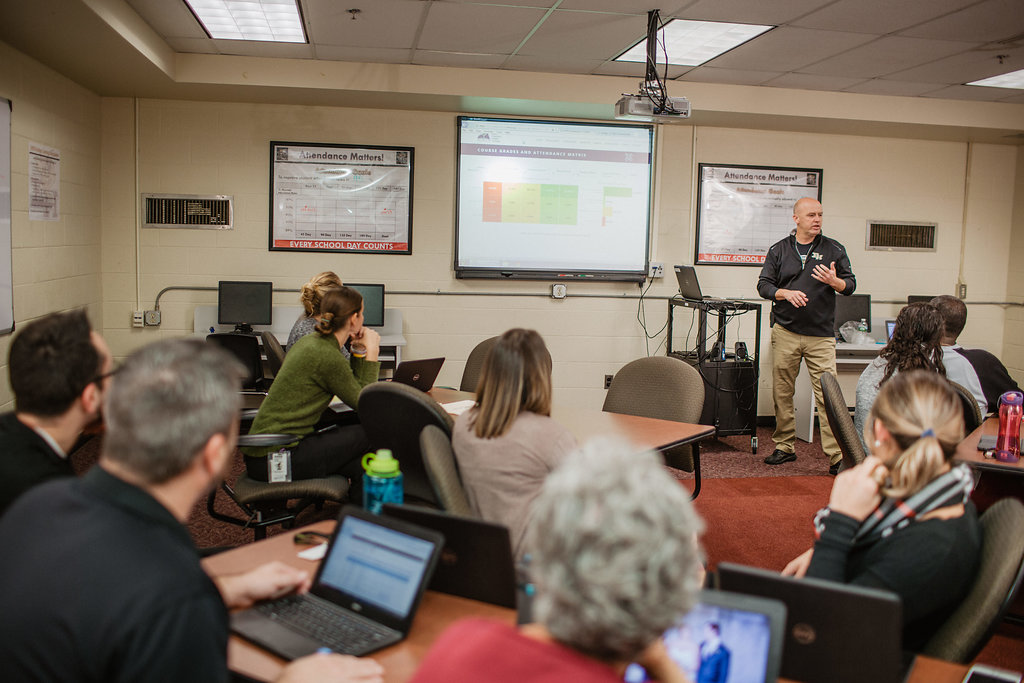
AB: Can you share more about the different levels of data educators have access to via the Data Hub?
EP: Absolutely. On the one hand, you have the most practical and individualized data that educators look at on a daily basis — think attendance, course grades, test scores, postsecondary plans, application submissions, FAFSA completion, and other indicators that tell us how engaged students are with their learning, how successful they are in their courses, and whether they’ve completed the necessary milestones for their postsecondary plan.
Educators use this information to meet students’ needs, often via 1:1 conversations in the classroom or even hallway, or in small groups. This micro data is invaluable. You simply cannot move the needle for individual students if you’re only looking at aggregate or end-of-quarter or end-of-year data.
At the same time, educators also need to have periodic moments to step back and look at the bigger picture. They need to understand how their work with individual students is translating into broader successes across disciplines and different indicators of success. For example: What is our on-track rate? What percentage of seniors have completed the FAFSA?
These “big data” questions help improvement teams analyze trends and identify issues they may need to collaborate around together as a grade-level or schoolwide improvement team.
From there, however, the conversation will eventually make its way back to individual students. Which students are off track? What do we know about them? What are our hypotheses as to how it might unlock a different level of engagement or success? Which strategies will work best for each kid? And which adult is taking responsibility for each next step?
For all of these conversations — the big, the small, and everything in between — we’ve co-designed protocols to help educators make sense of the data. We built these tools with educators and we coach our school partners on how to use them. We also regularly improve Hub resources based on educators’ real-life experience using the tools with each other and with their students and families.
AB: You mentioned students and families. How do they fit into all of this?
EP: Another big question we’ve explored alongside our school partners is how to provide data for students and families such that it’s really and truly built for them.
For example, our team has iterated on the on-track report over the years so that, today, it’s a really clear, accessible, and user-friendly tool. It’s the same data educators look at in their improvement team meetings, but packaged to be shared directly with students and families.
Unlike a report card, it’s proactive. Kids and families can do something with the information. It’s way more actionable than a typical conference. Students and parents/caregivers have found it really empowering.
Educators look at the report alongside students and parents/caregivers to review progress and invite students to share their improvement goals, all before the end of the marking period. Unlike a report card, it’s proactive. Kids and families can do something with the information. It’s way more actionable than a typical conference. Students and parents/caregivers have found it really empowering.
AB: Do you all use the Hub for anything else?
EP: As an organization, we also use the Hub for our own research and evaluation. We’ve seen that it’s not enough for us as a learning organization to look at individual data and trend lines. We have to approach data with the same inquiry lens that educators bring to the table. It’s not only “What’s working?” but also “Why is it working?” and “How?” and “For which kids?”
Our findings are strengthened by our network model. Because we have so many schools testing strategies in so many contexts, there is inevitably variability that we get to study and learn from. We might have 10 schools trying one strategy in 10 different ways. The Data Hub provides us with information to validate our overall approach along with the nuanced takeaways educators need in order to implement the right innovations to meet the distinct needs of their students and communities.
AB: Given everything you’ve learned over the past decade, how do you think about the role of innovation in RISE’s work today and in the future?
EP: After ten years of RISE, one thing I continue to marvel over is that I can take credit for very few, if any, of the life-changing innovations that have become part of our network.
All of the things that we’ve learned have been successful — On-Track Coaches, Summer Bridge, FAFSA supports — were born from and with our school partners. These innovations have emerged through an improvement process in which diverse and representative groups of educators come together and spot a need, dream up a solution, and try it out with a lot of gusto and hard work.
We’ve put schools and educators in the driver seat in creating real change in their communities, and that will continue to be the heart of our innovation model. We’re never going to be done improving, and we know that change cannot be top-down. It cannot be initiated through policy or imposed on schools from the outside. It has to come from the people who are doing the work. They are the experts. They have the solutions. They are the ones who are going to sustain the remarkable improvements we’ve seen across our school partners in the future.