
The RISE Network helps schools do something powerful: use data in real time to respond to student needs with creativity, urgency, and care. Working alongside educators, we support strategies that ensure more students stay on track and graduate ready for what comes next.
This shared commitment to student success is why we were thrilled to join the GRAD Partnership as an organizing partner. The student success systems (S3) framework — with its focus on actionable data, supportive relationships, student-centered mindsets, and strategic improvement — aligns deeply with how we approach our work every day.
Two RISE strategies — On-Track Coaching and Summer Bridge programs — show what it looks like when schools put the student success systems into practice. Both strategies to support Grade 9 on-track achievement were designed by educators in response to real challenges and are grounded in the belief that every student deserves to start high school with the support they need to thrive.
Centering Relationships and Actionable Data: On-Track Coaching
When educators in the RISE Network noticed high rates of ninth-grade course failures and limited bandwidth among counselors, they developed the On-Track Coach (OTC) model: full-time youth development professionals who support caseloads of up to 60 incoming ninth graders identified as high-risk or vulnerable based on their eighth-grade attendance, grades, and behavior.
This strategy is rooted in two student success system domains: strong relationships and connection and actionable data. OTCs build deep, trusting relationships through regular one-on-one check-ins, small group sessions, and consistent communication with families and school staff. They also serve as active members of improvement teams — a structure that mirrors the collaborative student success teams, which are the engine to the overall student success system — using on-track data to identify trends and drive support efforts.
And the data shows it’s working. A recent internal evaluation of the On-Track Coaching strategy showed:
- OTCs reached 60 percent of students with the highest needs, based on eighth-grade performance.
- Students on OTC caseloads were three times more likely to have a “high risk” or “vulnerable” Grade 8 status compared to their peers, using the University of Chicago’s Risk & Opportunity (R&O) framework.
- Despite these greater needs, caseload students ended the year just as likely to be on-track as their off-caseload peers — both groups at 85 percent on-track.
- OTCs also helped narrow the gap in college-ready GPAs (3.0 or higher) by 12 percentage points and chronic absenteeism by 11 points.

This is a clear example of how thoughtful case management, rooted in real-time data and trusted relationships, can level the playing field. OTCs didn’t just help students survive ninth grade — they helped them succeed, at rates that defied expectations based on middle school data alone.
Designing With Students in Mind: Summer Bridge
Traditional high school orientations — a few hours touring the building or hearing from upperclassmen — often fall short for students who are already anxious about the transition to ninth grade. That’s why schools in the RISE Network developed multi-day Summer Bridge programs, prioritizing enrollment for students with “high risk” and “vulnerable” profiles based on Grade 8 data.
These programs focus on the student experience and mindset, helping students feel seen, supported, and confident before the first day of school. They also advance equity-driven improvement — another Student Success System pillar — by using data to identify which students are most likely to benefit.
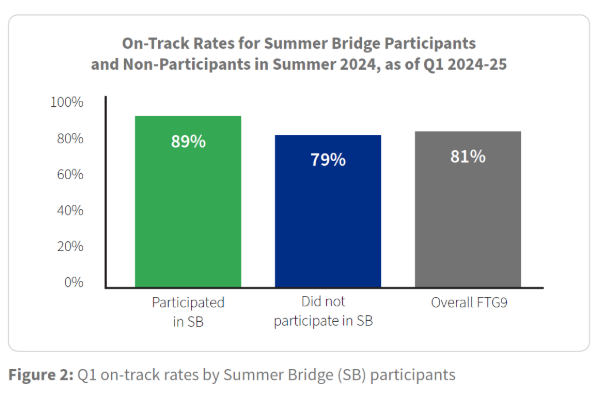
Results show that Summer Bridge participants had Quarter 1 on-track rates 10 percentage points higher than their peers, with especially strong results for students receiving special education services, multilingual learners, and students of color. Educators didn’t just predict who might struggle — they proactively designed experiences to change that trajectory.
Putting the System into Motion
Both the On-Track Coach and Summer Bridge strategies started with a core question: What do students need that they’re not getting — and how can we change that?
RISE schools used data not just to describe problems, but to solve them. They organized adults into effective teams, prioritized relationships, and centered students in every decision. That’s what it means to put student success systems into motion — and it’s what we’re excited to keep building together through this partnership.