
This school year, RISE is celebrating a special milestone: a decade of community, connection, and collective purpose. In looking back on the past ten years, we are reminded of how much we’ve learned and accomplished by supporting one another to experiment with new ideas and learn from both what has worked and what hasn’t — always returning to that fundamental question of why.
“The best thing about RISE is that we really value progress, not perfection,” says Rebecca Kruge, Postsecondary Success Manager at RISE. “When we introduce improvement science to school teams in the RISE Network, we emphasize that mistakes, missteps, and miscalculations often lead to the greatest opportunities for learning.”
That’s true in classrooms and schools, where RISE-supported educators regularly test and refine their change ideas. And it’s true for our organization, too.
Since launching the postsecondary support strategy five years ago, Kruge emphasizes that the RISE team has continuously refined our model to reflect emerging insights and lessons learned.
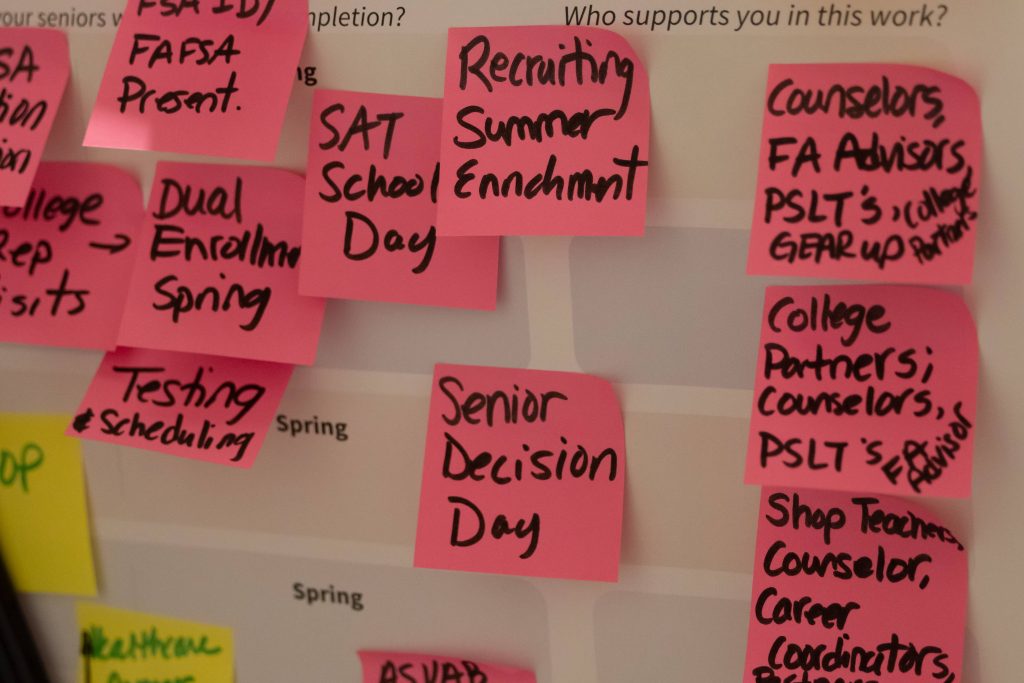
“Initially, the innovations we co-designed with our school partners included things like college visits and other college prep activities,” Kruge explains, by way of example.
That worked really well for many students. As RISE staff worked with school partners to better understand students’ goals for the future and help each senior craft a personalized postsecondary plan, the team learned that lots of kids were interested in the military, career training, or even stepping right into the workforce after graduation.
“We had to ask ourselves: what are we doing for them?” Kruge explains. The answer, she says, was “not nearly enough.”

“It was a pretty big oversight,” Kruge adds.
Kruge and her colleagues relied on the strong, trusting relationships they had built with school partners and one another to be vulnerable and acknowledge the gap — and move forward together. Those deeper coaching conversations yielded new ideas and strategies, which RISE coaches shared across the network to strengthen our collective approach.
Today, RISE’s postsecondary support is much more robust, encompassing a wider range of surveys and conversation tools to capture students’ college and career aspirations. A suite of integrated reports in the Data Hub make all of that information readily accessible and actionable for teachers, principals, and school counselors. Critically, postsecondary planning, while ramping up during eleventh grade, often begins during ninth grade — with specific milestones monitored through graduation.
The results have been profound. Initially, it took school teams nine or ten months to get a postsecondary plan in place for each of their twelfth graders. Today RISE school partners expect 95 percent of students to have their postsecondary plans documented by the end of the first semester of their senior year. And many high schoolers have plans in place much sooner, spurred by their completion of the RISE Junior Survey.
Kruge credits this dramatic improvement to the team’s learning orientation — a hallmark of the RISE approach — and commitment to regularly adjusting course to make our support as meaningful and impactful as possible for schools.
“This has continued to be the way that we approach the work,” she explains. “Once we figure something out, it’s always ‘What’s next? How do we keep improving?’”
But embracing setbacks can be tricky, especially when you’ve got a lot of experience under your belt. It can feel risky. There is an unspoken expectation that having one thing figured out means you’ve got everything figured out.
RISE School Improvement Coach Erin Asselin’s experience with High Tech High’s META Network on Attendance and Engagement is a reminder that there’s no room for ego in continuous improvement.
When the collaborative first came together in January 2025, Asselin was eager to jump into the network’s efforts to address chronic absenteeism. The RISE model was getting real results — in our 2025 annual report, Michelle Feist, Senior Program Officer at the Gates Foundation, explains that RISE had become a go-to partner for many organizations focused on continuous network improvement — and the META Network was another opportunity to showcase our strong approach.
“Our first change idea did not go well!” Asselin shares candidly.
To dive into the work on chronic absenteeism, Asselin and colleagues adapted RISE partner schools’ existing Grade 9 on-track priorities to fit into the META Network’s focal area. It was a little clunky, but they made it work. Being flexible enabled the team to keep up momentum halfway through the 2024-25 school year, when school teams were already mid-sprint with their improvement cycles.
By springtime, however, it was clear that the strategies weren’t yielding results. Chronic absenteeism rates in RISE partner schools had improved, but the changes weren’t nearly enough.
“We realized that we had to start over,” Asselin explains. “But that didn’t mean starting from scratch. We had learned a lot from our mistakes, and we had heard about everything that went well for others in the network. We used those insights to reinvent our approach.”
In other words, the team paused, took a breath, and stepped back into the RISE Improvement Cycle.
To start, Asselin and school partners reviewed data to more deeply understand which students were struggling with attendance and why.
“We wondered, ‘How were these students connecting, or not, with school? What was holding them back?’” she explains. This line of inquiry helped the team get really clear on which students to target for their chronic absenteeism goals.
They quickly identified two groups of students: those “on the cusp” of being chronically absent and those who were more severely disengaged. The team needed different strategies, tailored to the various root causes for students’ recurring absences. Depending on the student, progress would look different and it would occur on different timelines.
For the on-the-cusp kids, the team hypothesized that a small nudge might make a big difference. They initiated a “warm communication” strategy, sending texts to absent students and families with a friendly message: we miss you when you’re gone. As soon as a student was back at school, educators sent another text letting them and their families know how much their presence was valued. The assistant principal also prioritized catching each student in the hallway to say hello — a brief moment of connection to reinforce for students that they are seen and that they belong.
These small gestures turned out to be game-changing. Within a couple of months, the school teams saw measurable improvements in chronic absenteeism rates.
For the other group of more disconnected students the work continues, requiring a deeper, multi-pronged approach. But the improvement teams are keeping up the energy and momentum, buoyed by their early wins with the on-the-cusp kids.
For Asselin’s part, she’s looking forward to returning to the META Network this spring with the confidence and pride that come from a job well done — the second go-around.
“I can’t wait to share our results and everything we’ve learned,” she says. “And I can’t wait to see what innovations our network partners tested and learned from this past year.”
In 2026, we invite you to join RISE Network partners in adopting an improvement mindset, setting New Year’s resolutions that embolden you to try something new, and embracing the abundant opportunities for learning you’ll experience when things don’t go quite right on your first try.
Stick with it. Stay curious. You may be surprised at how successful your “mistakes” turn out to be.